The Evolution of Environmental Storytelling: Forza Horizon 6 and the Cultural Topography of Japan

The Horizon Festival has always been more than a racing circuit; it is a traveling circus of speed, music, and digital tourism. However, as the franchise moves into its sixth iteration, the shift from the sprawling deserts of Mexico to the dense, neon-soaked, and mist-shrouded landscapes of Japan represents more than just a change in map coordinates. It marks a fundamental evolution in how racing games utilize environmental storytelling to bridge the gap between arcade exhilaration and cultural immersion.
In Forza Horizon 6, the environment is no longer just a backdrop for a 200 mph speed trap; it is a living document of history, geography, and social friction. By meticulously reconstructing the contrast between the hyper-modernity of Tokyo’s Shinkansen corridors and the ancient, moss-covered silence of the Nara forests, Playground Games has crafted a world where the road itself tells a story. This article explores the deep technical and narrative layers of this digital Japan, examining how topography, weather, and architectural philosophy redefine the racing experience.
1. The Architectural Schism: Modernity vs. Tradition
The visual identity of Forza Horizon 6 is built upon the "Dual Japan" philosophy. This isn't just an aesthetic choice; it’s a structural one that dictates physics and player psychology. In the urban centers, the architecture is vertical, oppressive, and clinical. The game utilizes a new global illumination system that calculates the bounce of LED light off brushed aluminum and glass, creating a high-contrast environment where speed feels claustrophobic and kinetic.
Conversely, as players transition into the rural prefectures, the architecture shifts to horizontal wood-frames and clay-tile roofing. These structures are designed to blend into the landscape rather than dominate it. This shift in environmental geometry forces a change in driving style. The rigid 90-degree turns of the city give way to the organic, flowing radii of mountain passes, reflecting a transition from the "controlled" world to the "natural" world.
2. Shuto Expressway: The Concrete Arteries of Nightlife
The Shuto Expressway in Forza Horizon 6 serves as the game’s mechanical heartbeat. It is not merely a highway; it is a recreation of the Middo Naito Kurabu (Midnight Club) legacy. The developers have focused heavily on the acoustics of confinement. When driving through the elevated sections of the expressway, the sound of a high-revving RB26 engine echoes off the sound-suppression walls, creating a resonant frequency that changes based on the car’s proximity to the barrier.
The Engineering of Flow
- Expansion Joints: High-fidelity haptic feedback simulates the rhythmic "thump-thump" of bridge expansion joints, a sensory staple of Japanese highway driving.
- Toll Gates: These act as atmospheric checkpoints, slowing the pace briefly to allow the player to absorb the scale of the megalopolis.
- Variable Lighting: Dynamic billboards reflect off the car’s paint, with colors shifting based on the real-world density of the city's power grid.
3. Touge: The Sacred Geometry of the Mountain Pass
The inclusion of the Touge (mountain pass) represents the spiritual core of the game’s physics engine. Unlike the wide-open roads of previous titles, these passes are narrow, unforgiving, and mathematically precise. The hairpins are modeled with varying camber, requiring players to understand the weight transfer of their vehicles in a way that goes beyond simple drifting.
The environmental storytelling here focuses on the "worn path." You can see the history of the road in the skid marks left by previous AI "street racers" and the weathered guardrails. These roads feel lived-in; they are the arenas where local legends were born. The density of the foliage—recreated using photogrammetry of Japanese cedar and maple—creates a strobe-light effect as sunlight filters through the trees, challenging the player's vision and reaction times.
4. The Petrichor Engine: Rain and the Aesthetic of Sorrow
In Japan, rain is a season unto itself, and Forza Horizon 6 introduces the "Tsuyu" (monsoon) weather system. This is not just a visual filter. The game tracks the accumulation of water in the grooves of the asphalt, affecting tire temperature and hydroplaning risks. The reflection of neon signs on wet pavement—the Cyberpunk aesthetic—is utilized here to enhance the sense of speed and danger.
Atmospheric Layers
- Mist and Fog: Low-lying clouds in the highlands reduce visibility to mere meters, turning a high-speed sprint into a psychological horror game.
- Puddle Physics: Water depth is non-uniform, meaning hitting a pool of water at the wrong angle can pull the steering rack, requiring active counter-steering.
5. Rural Zen: The Silence Between the Revs
Between the high-octane events lies the "Silent Japan." This is a design philosophy where the game intentionally reduces the music and UI clutter. Driving through a village in the Shizuoka Prefecture, the soundscape shifts to the chirping of cicadas and the distant chime of a temple bell. This contrast is vital; it prevents "sensory burnout."
The storytelling in these areas is subtle. You might find an abandoned "bubble era" luxury hotel or a secluded shrine accessible only by a dirt path. These locations aren't marked as major objectives but serve as rewards for the curious driver. They provide a sense of place that makes the world feel larger than a simple playground for cars; it feels like a country with a soul.
6. The Neon Midnight: Light as a Narrative Force
As the game cycles into the night, the world undergoes a total transformation. In Tokyo, the darkness is artificial. The "Ray Tracing 2.0" implementation allows for every brake light and vending machine to act as a light source. This creates a hyper-reality where the car becomes a streak of light, a concept known in Japanese art as Ma (negative space) being filled with motion.
Lighting Tiers in Forza Horizon 6
- Tier 1 (Metropolitan): Saturated, high-frequency flickering, heavy use of blues and pinks.
- Tier 2 (Industrial): Harsh sodium-vapor yellows, long shadows, gritty textures.
- Tier 3 (Rural): Absolute darkness, reliance on high-beams, emphasis on the stars and moonlight.
7. The Cultural Garage: More Than Just Metal
In Forza Horizon 6, the relationship with the car is portrayed through the lens of Japanese Otaku culture. The garage isn't just a menu; it is a customizable space that reflects the player's journey. Tuning is presented as a form of craftsmanship (Monozukuri). The game dives deep into the specific subcultures of Japan, from the "Bōsōzoku" bikes and vans to the clean, "Kanjozoku" civic racers.
Each car has a "biography" that links it to a specific era of Japanese automotive history. When you drive a 1990s halo car, the game’s UI subtly shifts to reflect the digital displays of that era. This attention to detail ensures that the vehicle isn't just a tool for winning races, but a piece of cultural heritage that the player is entrusted to maintain.
8. Seasonal Flux: The Pink and The White
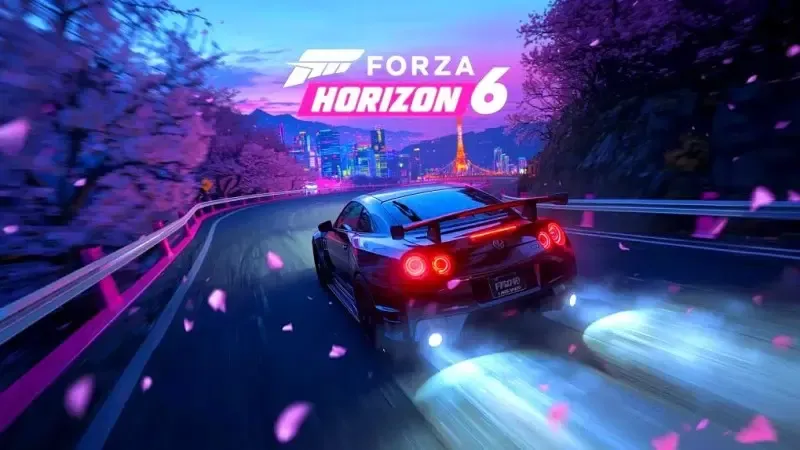
The seasonal rotation—a staple since Horizon 4—reaches its zenith here. The "Sakura" (Cherry Blossom) season isn't just about pink trees; it changes the road surface. Fallen petals create a "low-friction" layer on the road, similar to light snow. It’s a beautiful hazard that forces players to respect the season.
Then comes winter in the Hokkaido region. The game transitions into a hardcore off-road simulator. The snow is deep, deformable, and cold. The environmental storytelling here focuses on isolation. The roads are cleared by massive snowblowers, creating white canyons that echo the roar of engines. It is a stark, brutal contrast to the neon warmth of the southern cities.
9. The Sound of the Void: Electric vs. Internal Combustion
With the industry's shift toward EVs, Forza Horizon 6 tackles the "sound problem" head-on. In a country as quiet-conscious as Japan, the presence of a screaming V12 is a narrative act of rebellion. The game contrasts the silent, high-torque glide of modern electric supercars against the mechanical, vibrating chaos of vintage steel.
The "audio-scape" changes depending on where you are. In "Silent Zones" (historic districts), the game emphasizes the tires on cobblestones and the wind over the A-pillars. In "Industrial Zones," the mechanical noise of factories blends with the engine's drone. This sonic layering makes the world feel three-dimensional, reinforcing the player's impact on the environment.
10. The Horizon Spirit: A Synthesis of Past and Future
The conclusion of the Horizon Festival in Japan isn't a trophy; it’s a realization. The game ends by weaving together the disparate threads of its world—the high-tech, the ancient, the loud, and the quiet. The final "Goliath" race is a 50-mile loop that touches every biome, serving as a final exam for the player’s understanding of the Japanese topography.
Ultimately, Forza Horizon 6 moves the series from a "racing game" to a "world simulator." It proves that the most important part of a car game isn't the car itself, but the world that the car allows you to discover. By grounding the fantasy of the Horizon Festival in the reality of Japanese culture and geography, Playground Games has created a masterpiece of environmental storytelling.